

Hey there! As a supplier of Forklift Dock Plates, I often get asked about all sorts of technical stuff related to these handy products. One question that pops up quite a bit is, "What is the flexural modulus of a forklift dock plate?" So, let's dive right into it and break it down in a way that's easy to understand.
First off, what exactly is a forklift dock plate? Well, it's a crucial piece of equipment used in loading and unloading operations. It bridges the gap between a truck and a loading dock, allowing forklifts to move smoothly between the two. There are different types out there, like the Hydraulic Dock Plate, Adjustable Dock Plate, and Mechanical Dock Leveler. Each has its own perks, depending on your specific needs.
Now, onto the flexural modulus. The flexural modulus is a measure of a material's stiffness when it's being bent. In the context of a forklift dock plate, it tells us how much the plate can bend under a certain load without getting permanently deformed. It's kind of like testing how much you can bend a ruler before it snaps or stays bent.
Why is the flexural modulus important for a forklift dock plate? Well, think about it. When a forklift drives onto a dock plate, it's putting a lot of weight on it. If the dock plate doesn't have a high enough flexural modulus, it could bend too much, causing instability and potentially leading to accidents. On the other hand, if the flexural modulus is too high, the plate might be too rigid and could crack under stress.
To understand the flexural modulus better, let's look at the materials commonly used to make forklift dock plates. Steel is a popular choice because it's strong and has a good flexural modulus. It can handle heavy loads and doesn't deform easily. Aluminum is another option. It's lighter than steel, which makes it easier to move around, but it generally has a lower flexural modulus. So, if you need to move the dock plate frequently, aluminum might be a good choice, but you'll need to make sure it can handle the weight of your forklift and the loads it's carrying.
When we talk about the flexural modulus, we usually measure it in units of pressure, like pounds per square inch (psi) or megapascals (MPa). The higher the number, the stiffer the material. For example, a high - quality steel dock plate might have a flexural modulus of around 29 million psi, while an aluminum dock plate could have a flexural modulus of about 10 million psi.
Let's take a closer look at how the flexural modulus affects the performance of a dock plate. When a forklift drives onto a dock plate, the weight of the forklift and the load creates a bending moment on the plate. The dock plate needs to be able to resist this bending without excessive deflection. If the deflection is too large, it can cause problems like the forklift tipping or the load shifting.
Here's a real - world scenario: Let's say you're running a busy warehouse. You have forklifts constantly moving in and out, loading and unloading trucks. You need a dock plate that can handle the continuous stress. A dock plate with a high flexural modulus will be more reliable and durable. It'll be able to withstand the repeated bending caused by the forklifts passing over it day in and day out.
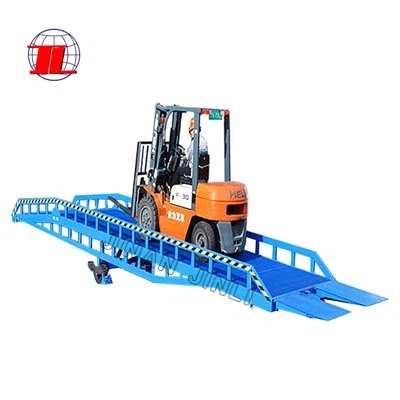

On the flip side, if you have a smaller operation with lighter loads, you might be able to get away with a dock plate that has a lower flexural modulus. Maybe you're using smaller forklifts or only moving light - weight products. In that case, you can save some money by choosing a less - rigid dock plate.
Another thing to consider is the design of the dock plate. The shape and structure of the plate can also affect its performance under load. For example, a dock plate with a ribbed design can distribute the load more evenly, reducing the stress on the material. This can effectively increase the apparent flexural modulus of the plate, even if the base material has a lower modulus.
Now, as a supplier, I know that choosing the right forklift dock plate can be a bit overwhelming. There are so many factors to consider, like the flexural modulus, the weight capacity, the size, and the type of material. That's where we come in. We have a wide range of dock plates available, and we can help you find the one that's perfect for your specific needs.
Whether you're looking for a Hydraulic Dock Plate for easy adjustment, an Adjustable Dock Plate to fit different truck heights, or a Mechanical Dock Leveler for a more traditional solution, we've got you covered.
If you're in the market for a forklift dock plate, don't hesitate to reach out. We're here to answer all your questions, provide you with the right information, and help you make an informed decision. Whether you're a small business owner or part of a large corporation, we can work with you to find the best dock plate for your operation.
To sum it all up, the flexural modulus of a forklift dock plate is an important factor that determines how well the plate can handle the load without deforming. It's influenced by the material used, the design of the plate, and the way the load is distributed. By understanding the flexural modulus, you can choose a dock plate that will keep your loading and unloading operations safe and efficient.
So, if you think it's time to upgrade your dock plate or you're just starting out and need to get one, hit us up. We're eager to assist you in finding the ideal forklift dock plate for your warehouse or loading dock.
References:
- Engineering textbooks on materials science and mechanics of materials
- Industry standards and guidelines for forklift dock plates


